
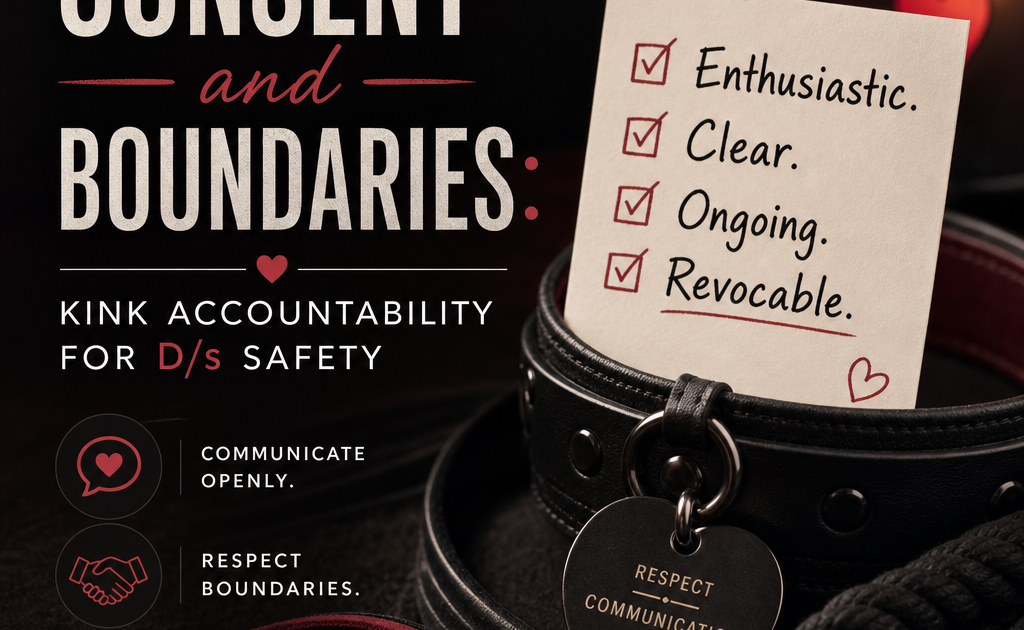
Consent, Boundaries, and Accountability: Keeping Structure Safe and Clear

Healthy power exchange works best when it is built on clarity, not confusion. Whether a dynamic is playful, romantic, or deeply structured, the foundation must always be trust. That trust is protected by consent and boundaries, sustained through kink accountability, and reinforced by careful D/s safety practices.
Without those three pieces, structure can become vague, stressful, or even harmful. With them, it becomes stable, respectful, and genuinely connective.
Why Structure Needs Consent First
Consent is more than a one-time yes. It is an ongoing agreement that should be informed, enthusiastic, and revisitable. In any dynamic involving authority, guidance, restraint, or rules, consent is what makes the structure ethical.
A clear agreement helps both people understand:
- What is allowed
- What is off-limits
- What behaviors need discussion first
- How either person can pause or stop the dynamic
- What happens if a boundary is crossed
When consent is explicit, expectations become easier to manage. Nobody has to guess what the other person meant. That reduces pressure and lowers the risk of misunderstanding.
Boundaries Are Not Obstacles
Boundaries are often treated like limitations, but they are actually tools for safety and confidence. A boundary tells you where the edge is so you can move near it without falling over.
In a structured relationship, boundaries may include:
- Physical limits
- Emotional topics that require caution
- Public versus private behavior
- Communication timing and tone
- Rules around scheduling, discipline, or aftercare
Good boundaries are not signs of weakness. They are signs that both people are paying attention. They help keep the dynamic sustainable by making room for real life, stress, and changing needs.
The Role of Accountability in Healthy Dynamics
Accountability is what keeps promises meaningful. In a dynamic with hierarchy or authority, it is easy for one person to assume that power automatically justifies every action. It does not. Power must remain answerable to agreed-upon standards.
That is where kink accountability becomes essential. Accountability means:
- Owning mistakes without defensiveness
- Checking in after difficult scenes or conversations
- Revisiting agreements when something feels off
- Correcting behavior when it crosses a line
- Being honest about capacity, mood, and limitations
A safe dynamic is not one where mistakes never happen. It is one where mistakes are addressed directly and respectfully. Accountability creates repair, and repair builds trust.
D/s Safety Is a Shared Responsibility
In consensual D/s, safety is never just one person’s job. A dominant can lead, guide, or set structure, but that does not remove the need to listen. A submissive can surrender control in specific ways, but that does not remove the right to speak up.
Strong D/s safety usually includes:
Clear negotiation
Before anything begins, both people should discuss expectations, limits, triggers, and goals. This conversation should be detailed enough to prevent confusion later.
Safe words or signals
A simple system for stopping or slowing down helps preserve trust. Nonverbal signals can also be useful if speech becomes difficult.
Regular check-ins
A dynamic can change with stress, health, work, or emotional state. Brief check-ins help catch issues before they grow.
Aftercare and decompression
After intense scenes or emotional exchanges, people may need reassurance, quiet, food, rest, or time alone. Aftercare is not optional when it is needed.
Ongoing review
What felt good last month may not feel good today. Revisiting the structure keeps the relationship responsive instead of rigid.
What Healthy Power Exchange Looks Like
At its best, power exchange is not about control for its own sake. It is about creating a container where both people can be honest, intentional, and secure. That means the structure should feel clear rather than mysterious.
Healthy dynamics usually have a few things in common:
- The rules are understandable
- The limits are respected without argument
- Each person can raise concerns safely
- Emotional intensity is balanced with care
- Authority is practiced with humility
This is what separates sustainable structure from performative control. The goal is not to look strict. The goal is to remain trustworthy.
Red Flags That Structure Is Getting Unsafe
Sometimes a dynamic starts well but becomes unclear over time. Warning signs may include:
- Pressure to agree quickly
- Dismissal of stated limits
- Punishment for honest communication
- Refusal to revisit agreements
- Blaming one person for all problems
- Confusing emotional dependency with commitment
These signs do not automatically mean the relationship is doomed, but they do mean the structure needs attention. A safe dynamic can handle correction. An unsafe one resists it.
Building a Clearer Dynamic
If you want a structure that feels strong and respectful, start with simple habits:
- Put agreements in writing if helpful.
- Review limits regularly.
- Treat consent as ongoing, not permanent.
- Practice accountability in both directions.
- Prioritize communication over assumptions.
- Make room for repair when something goes wrong.
These steps do not make a dynamic less authentic. They make it more real. Clarity is not the enemy of intimacy. In fact, it often makes intimacy possible.
Final Thoughts
Consent, boundaries, and accountability are not separate from structure. They are what keep it stable. When those elements are present, a dynamic has room to grow without becoming unsafe or unclear.
Whether you are new to power exchange or refining an existing relationship, remember that good structure is built on mutual respect. Consent and boundaries protect the people in the dynamic. Kink accountability keeps trust alive. And thoughtful D/s safety ensures the structure stays clear, intentional, and sustainable.